Introduction
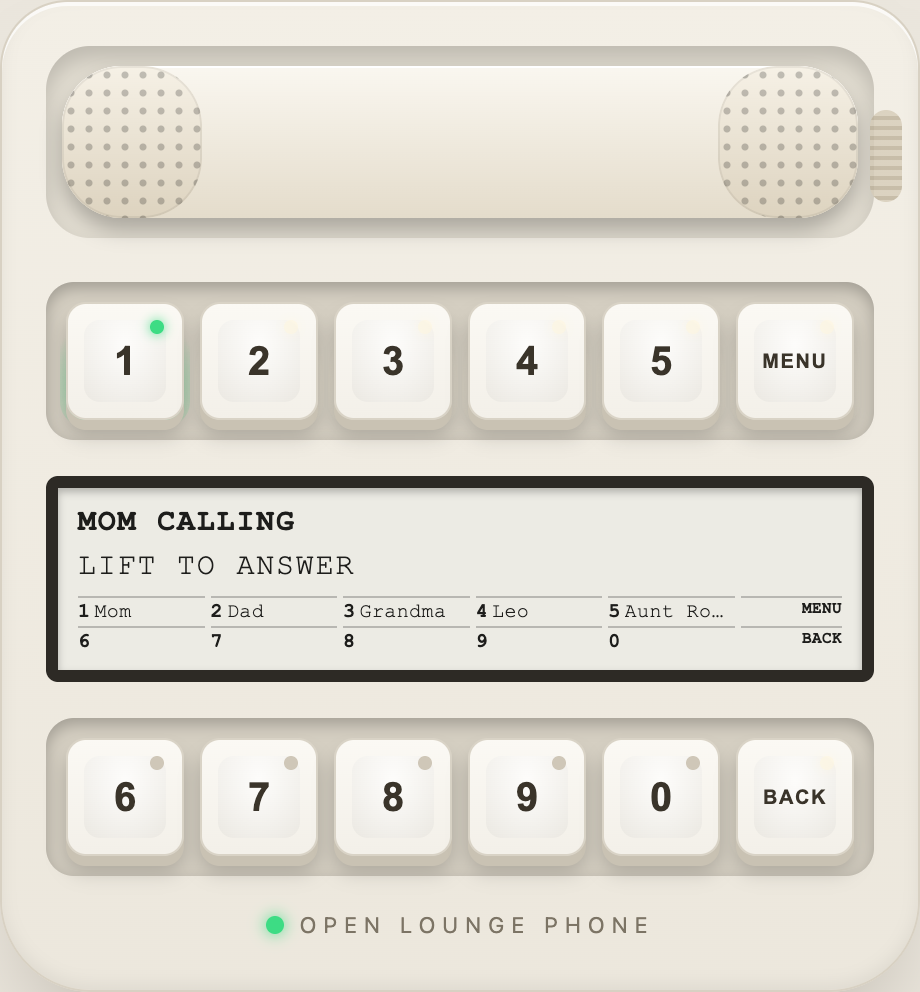
A free, open-source, screen-free phone. Big mechanical buttons, one per person, and nothing else: no browser, no games, no strangers.
- Kids’ phone — calls only the contacts a guardian approves, respects quiet hours (callers get voicemail with a transcript instead of waking anyone up), and reports its battery level.
- Lounge phone (later) — a shared booth phone you take over by scanning a QR code, which forgets you the moment you walk away.
Open Lounge Phone is “batteries included”: deploy the backend to your own free Cloudflare account or self-host it with Docker on hardware you control. Nobody — including this project — sits in the middle of your calls.
Status
Section titled “Status”Phase 1 (software, runs on ordinary computers) is in progress.
| Milestone | What | State |
|---|---|---|
| M0 | Monorepo, CI, licenses | done |
| M1 | Wire protocol + core logic (access control, quiet hours, call state machines) | done |
| M2 | Self-hosted server, browser phone emulator, companion app — first real call | done |
| M3 | Cloudflare backend (Workers, Durable Objects, D1, TURN) | done (local; see docs/cloudflare.md) |
| M4 | Kids’ features: invites, passkeys, voicemail + transcripts, richer device status | done |
| M5 | One-command deploy CLI, desktop app (Tauri) with USB keypads | next |
Later phases: Lounge variant → ESP32-S3 firmware on dev boards → custom PCB → wireless product. See docs/architecture.md.
Layout
Section titled “Layout”packages/protocol wire protocol (zod schemas) — the contract every device speakspackages/core pure domain logic shared by all backends and devicespackages/db SQL migrations + typed store (Cloudflare D1 and SQLite)packages/server-app backend-agnostic HTTP API, connection gateway, household call hubpackages/client browser helpers: socket, WebRTC call media, tonesapps/server-selfhost Node server (+ Dockerfile, compose.yaml with coturn)apps/device-web browser emulator of the phone (keys, LEDs, status display, handset)apps/companion companion PWA for guardians and contactsfirmware/ ESP32-S3 firmware (later phase)hardware/ KiCad PCB and enclosure (later phase)docs/ architecture and the generated protocol referenceTry it
Section titled “Try it”npm installnpm startOpen the setup link the server prints, create your household, then open
http://localhost:8787/device/ in another tab. That’s an emulated phone. Press Space to lift its
handset and it reads out a pairing code; enter it in the companion app, then call each other.
See docs/self-hosting.md for Docker and HTTPS.
Development
Section titled “Development”Requires Node 22+.
npm installnpm test # unit testsnpm run check # lint + typecheck + tests (what CI runs)npm run docs:protocol # regenerate docs/protocol.md after changing packages/protocolLicense
Section titled “License”Software: AGPL-3.0-or-later. Hardware designs: CERN-OHL-S-2.0. If you run a modified Open Lounge Phone server for others, you must share your changes.